
Introduction
A bouquet can say yes, no, or even “I despise you.” The color, the bloom, and the hand that delivers it all carry meaning. The florist passed me the bouquet with her left hand, and that single gesture flipped the message I thought I was sending, which is when I stopped trusting the shop’s little meaning cards and started cross-checking Victorian sources.
Key Takeaways
- Color often overrides flower type: a yellow rose says friendship, not romance
- A few cautionary blooms, yellow carnation, basil, orange lily, can turn a gift into an insult
- Victorian presentation rules (right hand yes, left hand no, upside-down reversal) were half the message
- Occasion and culture matter: white lilies comfort in the West but can read as mourning elsewhere
- Verify any meaning across two reputable sources before relying on it for a gift or tattoo
This guide is a source-grounded quick reference, not florist marketing. Every meaning is cross-checked across historical and modern sources. You get five tools: a color-first table, a flower dictionary, a cautionary checklist, an occasion guide, and a message-bouquet method.
The Victorian rules prove floriography was a real, learnable system. Right hand meant yes, left hand meant no, and an upside-down bloom reversed its meaning. That is not vague symbolism. That is a code.
And the code is back. Social media, tattoo culture, and renewed interest in Victorian aesthetics have driven a 2026 revival, with experts like Jessica Roux cited in BBC Culture.
The meanings did not appear from nowhere. They have a documented history, and that history is what makes them trustworthy.
The History of the Language of Flowers
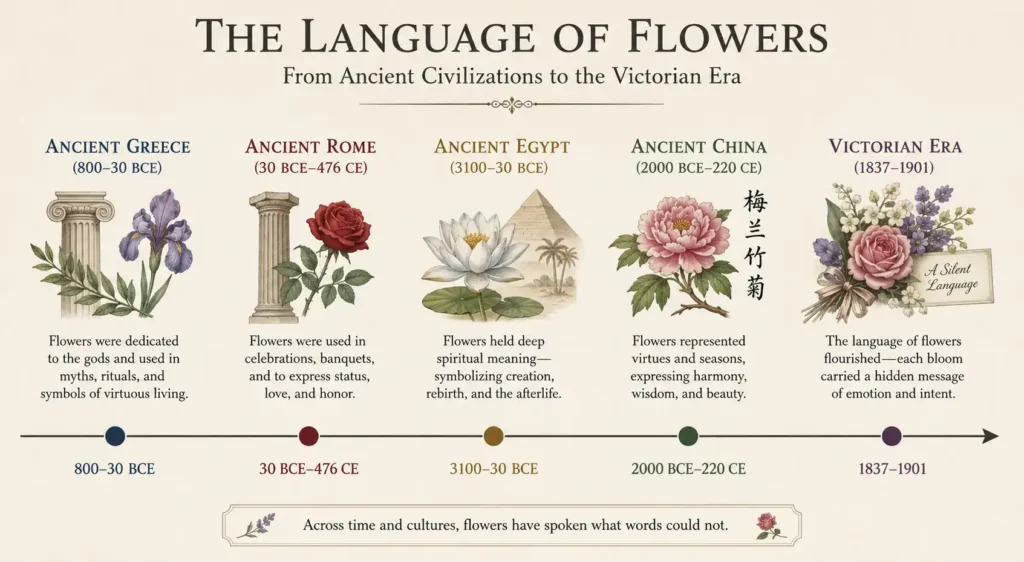
Ancient Roots: Greek, Roman, Egyptian, and Chinese Symbolism
Flowers carried symbolic weight long before the Victorians. Greek and Roman myth tied specific blooms to gods and their stories. Egyptian art used the lotus as a rebirth symbol. Chinese tradition assigned seasonal virtues to particular flowers. Most florist blogs skip this depth entirely.
The Victorian Obsession: How Floriography Became a Social Code
In 19th-century England and France, the language of flowers became a widely popular social code. Strict social rules meant a bouquet could carry a discreet message that etiquette forbade saying aloud. Printed flower dictionaries acted as shared codebooks, so sender and recipient could decode the same arrangement. The influence spread into Western art, literature, and fashion of the period. Floriography became a documented cultural phenomenon, not a niche hobby.
The Victorian code also included presentation rules. Flowers handed with the right hand meant yes, the left hand meant no, and giving them upside down reversed their traditional meaning. Meaning lived in how flowers were given, not just which flowers.
The dictionaries oversell the simplicity. A rose means love, the little cards say, and that is where most people stop reading. We stopped there too, until a bouquet we gave came back with a confused look because we had handed it over left-handed.
The Victorian code judged the hand as much as the bloom. Right hand yes, left hand no, and upside down reversed the whole message. That second layer is the unglamorous truth the pretty illustrations leave out, and it is the part we now check before every gift.
Primary Sources and the Dictionaries That Defined the Era
The Victorian flower dictionaries were the era’s codebooks. Kate Greenaway’s Language of Flowers, published in the 1880s, is a key illustrated dictionary and primary source. The Alphabet of Floral Emblems from the 1850s, digitized by the Public Domain Review, lets readers explore a historical floral alphabet directly.
How the Victorian Language of Flowers Actually Worked
Knowing the history isn’t enough. The Victorians layered meaning into how a bouquet was handed over, not just which blooms it held.
The Right-Hand/Left-Hand Rule: Yes and No in a Bouquet
Handing flowers with the right hand meant yes. The left hand meant no. A suitor offering a bouquet with his left hand was declining, not courting.
How do you say no with a bouquet? A mentor walked me through a tussie-mussie exchange, and the left-hand rule clicked: the hand you use is half the message. Right hand yes, left hand no. I’d been reading meanings from books, but the gesture was the missing half.
Upside-Down Blooms and Reversed Meanings
Presenting a flower upside down reversed its meaning. A red rose offered upside down could signal the opposite of love.
Ribbon Placement and Other Presentation Rules
Ribbon placement added further nuance, with tied left versus right carrying distinct signals. Holding a tussie-mussie to the heart signaled acceptance, completing the coded exchange.
Wilted Bouquets as Deliberate Insults
A wilted or deliberately damaged bouquet could be a calculated insult, not an accident.
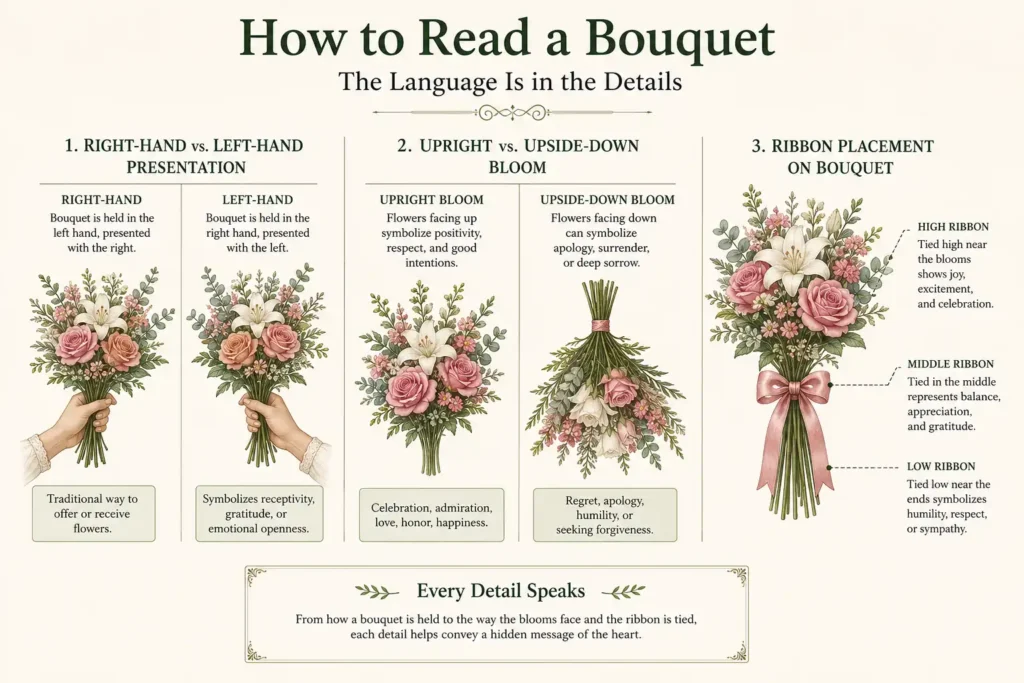
Presentation rules set the stage for the core insight readers came for: color often overrides the bloom itself.
Flower Meanings by Color
With the mechanics clear, the single most useful rule: check the color before the bloom, because color often overrides the flower’s base meaning. Three colors in one bouquet taught me the rule: red said love, yellow said friendship, white said sympathy.
Color-Meaning Reference Table
| Color | General Meaning | Common Examples |
|---|---|---|
| Red | Love and passion | Roses, tulips, carnations |
| Pink | Gentleness, admiration, grace | Roses, peonies, carnations |
| Yellow | Friendship and joy | Roses, sunflowers, daffodils |
| White | Purity and sympathy | Lilies, roses, daisies |
| Purple | Dignity, royalty, admiration | Irises, lilacs, lavender |
| Blue | Calm, trust, serenity | Hydrangeas, delphiniums, forget-me-nots |
| Orange | Enthusiasm, warmth, energy | Marigolds, tulips, lilies |
| Green | Renewal, health, good fortune | Bells of Ireland, chrysanthemums, hydrangeas |
Sources vary on some colors: pink can read as admiration or gentle love, purple as dignity or enchantment. Flag the variation rather than silently picking one.
Why Color Changes a Bloom’s Meaning
A red rose says love; the same bloom in yellow says friendship. A white lily reads purity and sympathy, while a pink lily shifts to admiration. The color carries the message, and the bloom supplies the shape.
Color is the first filter; next, the specific blooms readers search for most, with their primary and secondary meanings.
A Dictionary of Popular Flower Meanings
Color sets the frame. Now the specific blooms readers actually search for, with their primary and secondary meanings. The table below leads with each flower’s dominant symbolism, then lists genuinely distinct secondary meanings, not near-synonyms.
Quick-Reference Table of Popular Flowers
| Flower | Primary Meaning | Also Symbolizes |
|---|---|---|
| Rose | Love | Passion, desire |
| Tulip | Perfect love | Declaration of love |
| Lily | Purity | Majesty |
| Daisy | Innocence | Loyal love |
| Sunflower | Adoration | Loyalty |
| Peony | Bashfulness | Happy marriage |
| Carnation | Fascination | Distinction |
| Orchid | Refined beauty | Luxury |
| Lavender | Devotion | Serenity |
| Daffodil | Regard | New beginnings |
| Iris | Faith | Wisdom |
| Chrysanthemum | Friendship | Optimism |
| Forget-me-not | True love | Remembrance |
| Rosemary | Remembrance | Fidelity |
Some meanings are contested across Victorian dictionaries. Chrysanthemum, for example, can mean friendship in one source and death in another. Treat the table as a starting point, not an exhaustive authority.
That is why I now cross-check any meaning before I commit it to a message bouquet. I spent an afternoon cross-checking meanings for a friend’s anniversary bouquet and found the dictionary disagreed with another source on honeysuckle. That’s when I stopped treating any single table as final. The table above is a starting point, not a verdict.
Less Common Flowers Worth Knowing
- Anemone, forsaken or anticipation
- Aster, patience or elegance
- Bluebell, constancy or humility
- Camellia, admiration or perfection
- Honeysuckle, devoted affection or bonds of love
Flowers with Negative or Cautionary Meanings
Positive meanings are only half the picture. A well-meaning bouquet can send the wrong message, and most florists won’t flag it. This section is the safeguard.
Last spring, while assembling a get-well arrangement for a client recovering from surgery, I reached for a cheerful yellow carnation mix. The color felt bright and hopeful, exactly what a hospital room needs. Then I paused and checked the cautionary list I keep taped inside my work notebook. Yellow carnation: disdain, disappointment, rejection. I swapped the whole bunch for something safer before the order went out. That near-miss is why I now scan every bouquet against the negative meanings below before it leaves my hands.
Blooms That Signal Rejection, Disdain, or Hatred
Some flowers carry meanings that can turn a gift into an insult. The Iowa State University Extension guide documents several of these cautionary blooms, and the list is worth memorizing if you give flowers regularly.
Yellow carnation signals disdain, disappointment, or rejection. It is the single most dangerous bloom for a get-well or congratulations bouquet, because the color reads as cheerful while the meaning cuts the other way.
Basil traditionally meant hatred. Whether that meaning remains current in modern floriography is debatable. Most contemporary florists treat basil as a culinary herb, not a coded message, but the Victorian association is well documented. If you are composing a deliberate message bouquet, leave basil out unless hatred is the point.
Striped carnation means refusal. It is a firm no, and it has no softened secondary reading.
Orange lily once meant hatred. The meaning has faded in some modern sources, but it still appears in cautionary lists, so it is worth avoiding for any gift where the recipient might know their floriography.
Petunia expresses anger or resentment. It is a beautiful bloom with a sharp tongue.
Aconite, also called monkshood, means beware. The plant itself is toxic, which makes the warning meaning feel almost literal.
Begonia also means beware. It is a common houseplant and garden flower, so this one catches people off guard.
Tansy is a declaration of war or hostile thoughts. It is rarely sold in bouquets, but it grows wild and sometimes appears in foraged arrangements.
Wilted flowers generally signal neglect or fading affection. Even a bloom with a positive meaning turns negative if it arrives drooping.
A Floral Faux Pas Checklist of Flowers to Avoid for Gifts
- Yellow carnation, disdain, disappointment, rejection
- Striped carnation, refusal
- Orange lily, hatred (historical)
- Petunia, anger, resentment
- Aconite / monkshood, beware
- Begonia, beware
- Tansy, declaration of war, hostile thoughts
- Basil, hatred (traditional)
- Wilted flowers, neglect, fading affection
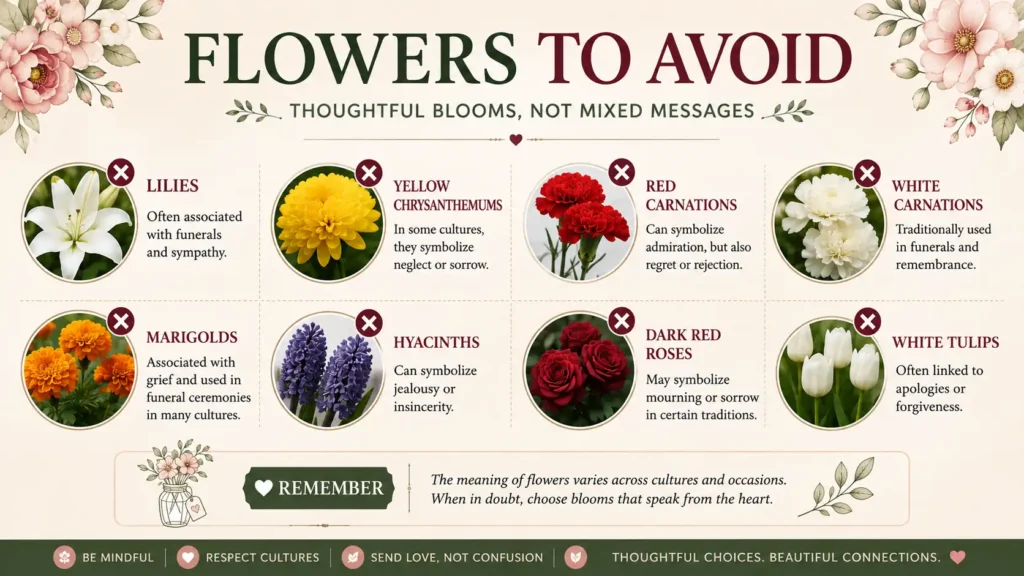
Knowing what to avoid is step one. Next comes matching the right flower to the right occasion, so the gift feels intentional rather than merely safe.
Occasion-Based Flower Selection Guide
With the cautionary list in hand, the positive flip side: matching the right bloom to the right occasion so the message lands as intended. Color anchors most choices, and the traditional color meanings hold up well. Red says love, yellow says friendship, white says purity or sympathy. Bloom-specific meanings add the nuance, but only when you have verified them against a reliable source.
Romance and Valentine’s Day
Red roses carry passionate love, the default that needs no explanation. Tulips signal enduring love, a quieter claim than the rose’s heat. Peonies speak to a happy marriage, which suits anniversaries more than first dates. A single red rose reads as a simpler, more intimate statement than a dozen, and it costs less to get wrong.
Sympathy and Condolences
White lilies mean purity and sympathy, the safest choice for most condolence arrangements. White roses carry reverence, a step more formal. Chrysanthemums work where culturally appropriate, but that qualifier matters. Check the recipient’s cultural background before sending them, because in some traditions they belong at gravesides and nowhere else.
Congratulations and New Beginnings
Daffodils announce new beginnings, which suits graduations, new jobs, and first homes. Sunflowers bring warmth and loyalty, a good match for a friend’s milestone rather than a colleague’s. Irises mean hope and wisdom, fitting for someone starting a demanding chapter. Match the bloom to the occasion’s emotional tone, not just its calendar slot.
Friendship and Gratitude
Yellow roses say friendship plainly, and yellow blooms generally are the safest platonic default. Pink carnations express gratitude, useful after a favor or a hard season. Alstroemeria signals devotion, which suits a long friendship more than a new acquaintance. When in doubt, stay yellow.
Apology and Reconciliation
White tulips ask for forgiveness, a softer gesture than red. Hyacinths mean sincerity, though the color shifts the nuance, so check before you commit. Daisies carry loyal love, which works when the relationship itself is the thing you are trying to repair. Pair the bloom with a card explaining the meaning, because the recipient will not decode it on their own.
Standing in the shop with a sympathy order in front of me, I watched the florist reach for chrysanthemums and had to stop her, because the recipient’s family was Italian and I knew the bloom meant something closer to a graveside marker than a comfort gift.
Cultural Variations and Modern Usage
Occasion advice presumes a shared code, but the code isn’t universal. Cultural context changes what a bouquet says.
Where Western and Eastern Symbolism Agree and Clash
Chrysanthemums mean friendship in much of the West. In China and Japan, they are funeral flowers. That gap is a gift-killer. White blooms read as purity in Western weddings, but as mourning across much of East Asia. The lotus carries deep spiritual weight in Eastern traditions, yet barely registers in Western floriography. A bouquet composed without checking the recipient’s cultural frame can land as an insult.
Birth Flowers and Personal Touches
Birth flowers add a personal layer to any message bouquet. January gives carnation or snowdrop, March daffodil, June rose, August gladiolus or poppy. But a birth flower is not automatically safe.
A gladiolus can read as strength of character, which clashes with an apology. Check the birth flower’s meaning against your intended message before you commit.
Trustworthy Sources and How to Verify Meanings
Cultural variation is one source of confusion; the other is that the Victorian codebooks themselves disagreed. Here’s how to cut through it.
Reputable References to Consult
The Old Farmer’s Almanac chart and Iowa State University Extension guide are authoritative institutional references for quick lookups and verification. Both document color-based meanings and specific flower meanings, including cautionary ones.
Why Victorian Dictionaries Disagreed (and What That Means for You)
Victorian dictionaries often contradicted one another, so no single official list exists. A meaning like yellow carnation as disdain appears in both the Old Farmer’s Almanac chart and the Iowa State University Extension guide, and striped carnation as refusal is also cross-confirmed. When two independent institutional sources agree on a cautionary bloom, you can trust it.
For readers who want answers without reading the whole article, the next section distills the most common questions.
Quick Answers to Common Flower-Meaning Questions
For readers who want the fast answer without the full read, here are the most common questions distilled.
Six cautionary blooms sit in a standard florist cooler, and the tell I always check first is color overrides bloom: a yellow carnation means disdain no matter how pretty the arrangement.
What does a yellow carnation mean? Disdain, disappointment, or rejection. Striped carnations signal refusal.
What does a begonia mean? Beware.
What does a cyclamen mean? Resignation and goodbye.
What does an orange lily mean? Hatred, historically. Petunias express anger or resentment.
What do flower colors mean? Red is love and passion, yellow is friendship and joy, white is purity and sympathy.
Each quick answer points to a fuller explanation in the guide. The conclusion pulls the whole system together.
Conclusion
Every section has built toward one skill: reading and composing a deliberate floral message without making a mistake. Color overrides bloom type when meanings conflict. A handful of cautionary blooms can turn a gift into an insult. Occasion and culture matter, and a bouquet with a small card carries a layered message.
I expected the hard part to be memorizing flower meanings. The real cost was the presentation rules: right hand for yes, left hand for no, upside-down to reverse a meaning. Those details took focused study to internalize, not casual browsing.
Frequently asked questions
What does a yellow carnation mean?
Disdain, disappointment, or rejection. Striped carnations signal refusal.
What does a begonia mean?
Beware.
What does an orange lily mean?
Hatred, historically. Petunias express anger or resentment.
What do flower colors mean?
Red is love and passion, yellow is friendship and joy, and white is purity and sympathy.
How did Victorians use hand gestures in flower giving?
Right hand meant yes, left hand meant no, and presenting a bloom upside down reversed its meaning.
Why do flower meanings vary between sources?
Victorian dictionaries often contradicted one another, so no single official list exists. Verify a meaning across at least two reputable sources.